
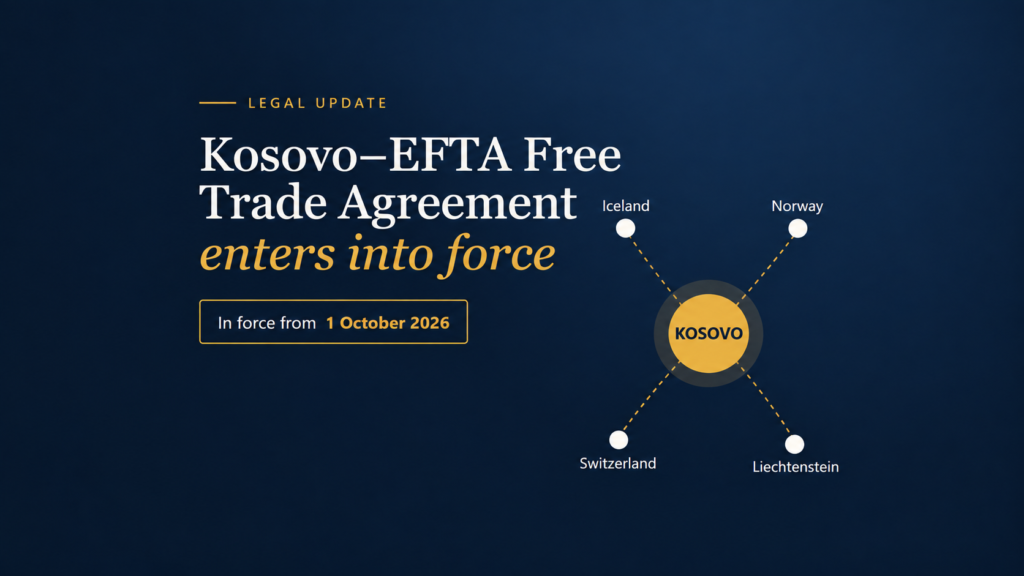
The Free Trade Agreement between Kosovo and the EFTA States, which include Switzerland, Norway, Iceland and Liechtenstein, will fully enter into force on 1 October 2026, establishing a new framework for trade and economic relations between Kosovo and the EFTA markets, creating benefits on both sides through increased opportunities for exports and imports.
In particular, the Agreement will allow qualifying Kosovo-origin goods to benefit from preferential or reduced customs duties, making exports more competitive and potentially reducing import costs for businesses trading with EFTA countries. It also improves the framework for cross-border services and provides greater certainty for businesses through agreed rules on origin, customs procedures, intellectual property and other trade-related matters.
The Agreement covers trade in goods, technical barriers to trade (TBT) and sanitary and phytosanitary measures (SPS), trade in services, intellectual property rights, trade facilitation, trade remedies, competition, trade and sustainable development, as well as legal and horizontal provisions. For businesses trading goods, one of the most significant changes is the availability of preferential customs treatment, subject to compliance with the applicable rules of origin and supporting documentation. In this respect, Kosovo manufacturers and exporters should therefore review their supply chains, production processes and origin records to determine whether their products qualify.
The Agreement also creates opportunities for service providers, while businesses must continue to comply with applicable regulatory, technical, safety, labelling and licensing requirements in the relevant EFTA market. Reduced customs barriers do not, in themselves, guarantee unrestricted market access.
From a contractual perspective, businesses should review supply, distribution, agency, licensing and other cross-border agreements to ensure that responsibilities for customs procedures, proof of origin, regulatory compliance and associated costs are clearly allocated. The Agreement’s intellectual property provisions are also relevant to businesses involved in licensing, franchising, technology transfer and distribution.
In conclusion, the entry into force of the Agreement should be considered as an opportunity for all businesses engaging in Kosovo and EFTA markets to review their customs and origin arrangements, regulatory compliance and existing commercial contracts, while assessing new opportunities for further market access.